Charles Sprawson – Haunts of the Black Masseur
Tastes may change, but surely some things are eternal? Apparently not. Take Love, our one common bond, our human birthright (right?). A medieval fabrication, thought C. S. Lewis: no one falls in love in the Aeneid. Charles Sprawson’s Haunts of the Black Masseur does not talk about Love, but it does talk about swimming – which, one would imagine, has been practised in more or less the same way and with the same alacrity since our ancestors first grew lungs and hauled themselves ashore.
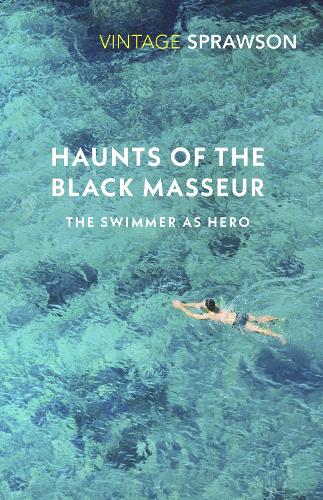
One would be wrong, though. The Romans were mad for it, as we know – “swimming was so popular that the inability of the Emperor Caligula to swim caused comment” – but throughout the Middle Ages “instances of swimming in England were rare and sporadic. Almost no one swam in the sea”. How does Sprawson know this, we might ask? We have to take him on trust as a man who, while teaching Latin in a moistureless Saudi Arabia, became “acutely sensitive to the slightest trace of water, any passing reference to swimming”. Aquatics turned into a physical and intellectual obsession, somehow not hindered by a longtime bathophobia:
My dread of deep water stems from a voyage to India at the age of six…As we rowed out from the shore across the shallow water the bottom dropped down suddenly at the edge of a steep massive cliff, and we found ourselves floating in clear smooth water over rocks rising up from an apparently unfathomable depth to quite near the surface…those submarine peaks rising abruptly from the seabed has marked my imagination for life.
Depth (my own comparably vertiginous memory would be the sight of a rusty buoy chain plunging silently into the dark of Lake Windermere) is Sprawson’s main criterion for swimmers. We learn that Shelley repeatedly courted drowning before it actually happened: according to Trelawney, he once lay “stretched out on the bottom [of the Arno] like a conger eel, not making the least effort or struggle to save himself”. Byron was the exact opposite, a supreme swimmer who showed little interest in what lay beneath the waves, but this blitheness was to his advantage when he came to cross the menacing drops of the Hellespont. For Sprawson, it all suggests “the superficiality of Byron’s imagination as well as nerve…His genius was for the surface of life.” Byron himself wrote “I plume myself on this achievement more than I could possibly do on any kind of glory, political, poetical or rhetorical”, which is consistent with his line in Beppo: “One hates an author that’s all author”.
Of these same we see several, and of others,
Men of the world, who know the world like men,
Scott, Rogers, Moore, and all the better brothers,
Who think of something else besides the pen…
Much space is also given to Algernon Charles Swinburne, who, true to type, approached swimming as an almost flagellative activity. He took “a masochist’s delight in being scraped by pebbles, pounded by waves”, needs met by the sea off Northumberland, where he spent his summer holidays. Sprawson then counter-chronologically moves to the famous opium-eater Thomas de Quincey, and draws compelling parallels between drug trips and the swimmer’s sense of temporo-spatial suspension:
Anyone who submerges some way below the surface into deep water can experience the nightmare visions of de Quincey’s…of sinking down through huge vaulted airless spaces, among rocks and columns that rise up from the ocean floor in a limitless and yet claustrophobic expansion of space, alone, but not unobserved; there is a sense that one is always under surveillance, invisible enemies and predators are somewhere hidden…the slightest touch or sound can cause alarm in this silent world.
Sadly, the rest of Haunts of the Black Masseur is not quite as interesting. From halfway onwards, we essentially tootle through the personal swimming habits of selected literary individuals – which we had also been doing previously, but which the Byronic chutzpah had kept us from noticing. A history of any commonplace pursuit is always going to struggle with the archives – in 300 millennia of homo sapiens, what percentage of human dips have been recorded in diaries and letters, never mind in canonical poems? Sprawson’s is necessarily the tip-of-the-iceberg technique. Edgar Allan Poe, Allen Tate and Mark Twain all enjoyed splashing around, so he contends that “swimming became established in the Southern imagination as a symbol of evasion, a means of refuge and withdrawal.” Whether the average Alabaman or Arkansawyer saw it like that, we can never know.
A book like this was never going to be comprehensive, but we might have wished it a little less occidental. We learn that it was the Native Americans who taught the world the front crawl/freestyle, at a time when everyone was swimming breaststroke. Otherwise, non-western traditions have to wait until the final, Japanese-focused chapter, where we are told that “Swimming was by no means an exclusively masculine pursuit” – though on page 284 out of 305, we could be forgiven for thinking it was. The women in question are the Ama, who for 2,000 years have dived off Honshu’s shores for shellfish and seaweed, going down as far as sixty feet. “Men”, Sprawson tells us, “are excluded because they could not stand the cold”. Which begs the question: if women can go deeper, why doesn’t Haunts of the Black Masseur go into depth on them?
Haunts of the Black Masseur is published by Vintage and is available here.
 Bookstalling